
Electronic leak detectors have become a standard tool in modern HVACR service. They’re fast, sensitive and incredibly useful for identifying the presence of a leak. But experienced technicians know one thing: A detector hit doesn’t always prove the exact source.
To make a confident repair—and avoid callbacks—electronic detection should be followed by visual confirmation at the suspected joint, fitting or component. That’s where professional-grade chemical leak detectors come in. Together, these methods create a more reliable, accurate and defensible leak detection process—and when appropriate, give customers confidence by showing exactly what was leaking.
Electronic Leak Detection: A Valuable First Step
Electronic leak detectors excel at quickly identifying whether refrigerant is escaping from a system. They’re especially helpful when:
- Scanning large systems
- Checking hard-to-access components
- Narrowing down the general area of a suspected leak
However, electronic detectors typically provide indication, not confirmation. They alert you that refrigerant is present—but they don’t show you where it’s coming from. Air movement, residual refrigerant, cleaning solvents or even environmental conditions can sometimes trigger readings that are difficult to interpret.
That’s why seasoned HVACR technicians treat electronic detection as the starting point, not the final answer.
Why Visual Leak Confirmation Matters
Visual confirmation removes ambiguity. When you can see a leak forming bubbles at a specific joint, fitting or component, there’s no guesswork involved.
This is especially critical when dealing with:
- Microleaks that may not trigger strong electronic readings
- Slow, long-term leaks that cause gradual refrigerant loss
- High-vibration areas where leaks develop intermittently
- Low-pressure conditions where electronic detection can be inconsistent
Skipping visual confirmation increases the risk of incomplete repairs, repeat service calls and continued refrigerant loss—all of which impact system performance and customer trust.
The Professional Workflow: Detection, Then Confirmation
A best-practice HVACR leak detection workflow uses multiple tools—each for what it does best.
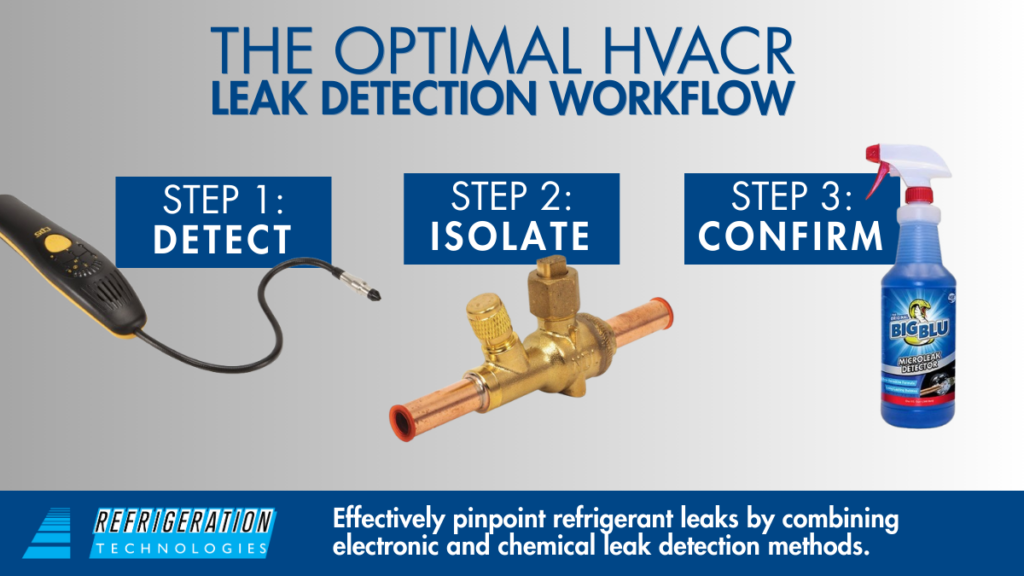
- Use an electronic leak detector to locate the general area of concern
- Isolate suspect components such as fittings, valves, brazed joints or coils
- Apply a chemical leak detector to visually confirm the exact leak location
This layered approach improves accuracy and efficiency. Electronic detection narrows the search, while chemical detection provides definitive proof.
For technicians who value precision and accountability, visual confirmation isn’t redundant—it’s essential.
Why Chemical Leak Detectors Excel at Pinpointing Microleaks
Chemical leak detectors work by reacting directly at the leak site, forming bubbles when refrigerant escapes. This makes them uniquely effective at identifying extremely small leaks that might otherwise go unnoticed.
Key advantages include:
- High sensitivity to microleaks
- Clear visual evidence of the exact leak point
- Effectiveness at low pressures
- Consistency across refrigerants and gases
Because chemical solutions stay in place, they allow leaks to reveal themselves over time—something electronic tools can’t always do when leaks are slow or intermittent.
What to Look for in a Professional-Grade Chemical Leak Detector
Not all bubble solutions perform equally in real-world HVACR environments. Experienced technicians should look for products that offer:
- Proven microleak detection capability
- Non-corrosive formulations safe for system components
- Performance across a wide temperature range
- Compatibility with all refrigerants and gases
- Safety for use in sensitive environments, including food-related applications
The quality of the solution matters—especially when diagnosing leaks that could otherwise be missed.
Big Blu: Visual Leak Detection Built for HVACR Professionals
Big Blu chemical leak detectors are designed specifically for professional HVACR applications, where accuracy, safety and reliability matter.
All Big Blu solutions share key benefits:
- Water-based, non-toxic and biodegradable
- Non-corrosive and safe on system components
- NSF certified for use around food
- Safe for use with any type of gas
- Engineered for microleak detection
Choosing the Right Big Blu for the Job
- Original Big Blu: Ideal for everyday HVACR and refrigeration leak detection
- Big Blu Subzero: Formulated for reliable performance in subzero temperatures
- Big Blu Brush On: Designed for precise application in tight or vertical spaces
Each option supports visual confirmation where electronic detection leaves uncertainty.
Better Confirmation Leads to Better Repairs
Visually confirming leaks allows technicians to:
- Make precise, targeted repairs
- Reduce repeat service calls
- Prevent ongoing refrigerant loss
- Increase customer confidence in the repair
When you can show a customer the exact source of a leak, you reinforce both the quality of your work and the professionalism of your process.
Confidence Comes from Seeing the Leak
Electronic leak detectors play an important role in modern HVACR diagnostics—but they shouldn’t be the final step. Visual confirmation with a chemical leak detector provides the clarity and certainty that professional technicians rely on.
By combining electronic detection with proven chemical solutions like Big Blu, HVACR technicians can ensure even the smallest leaks are found, confirmed and addressed—leading to better system performance, fewer callbacks and repairs done right the first time.