
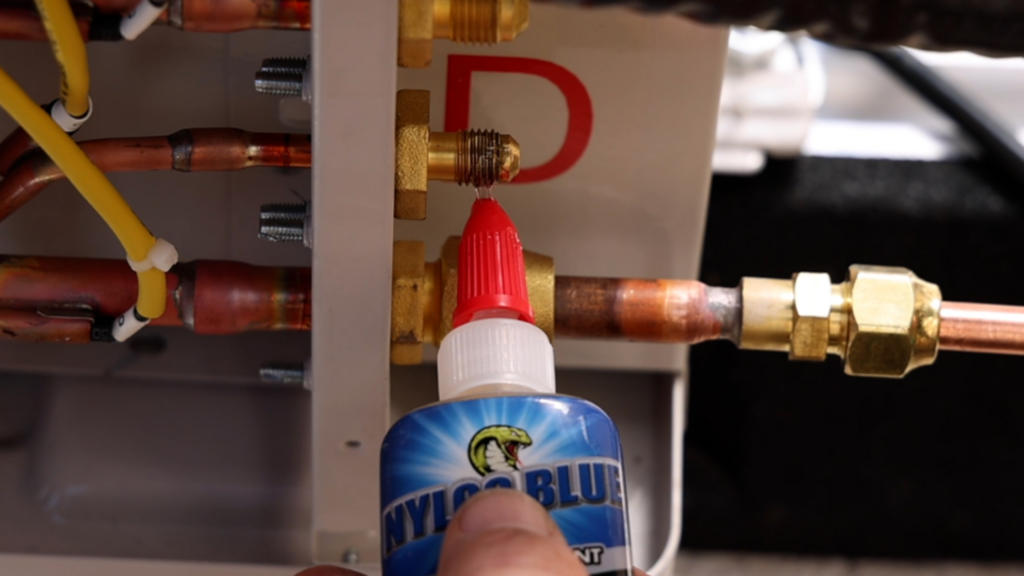
In the field, sealing threaded connections is second nature, but how you seal them can impact more than just whether a joint leaks .
Most technicians have used permanent or semi-permanent thread sealants like pipe dope, PTFE tape or other compounds designed to lock in a connection. They’re proven, familiar—and in the right applications— perform exactly as intended.
But refrigeration systems aren’t static–they operate in a closed environment with circulating oil and refrigerant, constant pressure changes and components that are often serviced more than once.
That’s where the focus shifts from simply sealing a connection to choosing a solution that supports long-term system performance.
What Permanent Thread Sealants Are Designed to Do
Traditional HVAC thread sealants are built to:
- Fill gaps in threaded connections (typically NPT)
- Prevent leaks under pressure
- Stay in place long-term, often by partially curing or setting
In plumbing, gas piping and other static systems, that approach makes sense. The connection is made, sealed and rarely revisited.
In HVACR, those same products are still commonly used, especially on pipe threads outside the refrigerant circuit. But within refrigeration systems, the operating environment introduces additional considerations that go beyond initial sealing strength.
Why Refrigeration Systems Require a Different Approach
Refrigeration systems are dynamic by nature. You’re dealing with:
- Circulating compressor oil
- Refrigerant moving throughout the system
- Temperature and pressure fluctuations
- Components that may need to be accessed, adjusted, or replaced over time
Because of this, sealing solutions need to do more than just prevent leaks. They need to work in harmony with the system itself.
Key considerations include:
Compatibility
Materials used on connections may come into contact with refrigerant and oil. Using a product that aligns with system chemistry helps reduce the risk of introducing unwanted variables.
Serviceability
Connections in HVACR systems are rarely permanent. Being able to disassemble and reassemble without excessive cleanup or damage is a practical advantage in the field.
Application Range
Not all sealing points are threaded pipe connections. Flare fittings, O-rings and valve components all require proper seating and lubrication to perform correctly.
Where Nylog Delivers an Advantage
Nylog™ is designed specifically with these system realities in mind.
Rather than functioning strictly as a traditional thread-locking compound, Nylog is a refrigeration-grade gasket and thread sealant made from compressor oil. It’s engineered to support both sealing and assembly across multiple connection types.
In practical terms, that means it helps:
- Improve sealing performance at connection points
- Reduce friction during assembly
- Support proper seating of flares, gaskets, and seals
- Maintain performance over time without drying out
Nylog’s formulation allows it to integrate naturally into HVACR systems rather than sitting outside of them.
Compatibility as a Performance Advantage
One of the biggest differentiators with Nylog is its compatibility with system oils and refrigerants.
- Nylog Blue™ is fully miscible with most modern refrigerants and synthetic oils, including A2L systems
- Nylog Red™ is formulated for systems using mineral oil-based refrigerants
Because of this, Nylog:
- Aligns with system chemistry
- Maintains stability under operating conditions
- Supports long-term system integrity
In applications where even small amounts of material may migrate beyond the connection point, using a product designed for that environment can make a meaningful difference.
A quick note on Nylog White™
It’s also important to match the product to the application.
Nylog White is a non-hardening gasket and thread sealant designed for air, water, gas, steam and glycol systems. It is not formulated for refrigerant and oil compatibility, so it should not be used on refrigeration systems.
The bottom line: In HVACR, compatibility isn’t a bonus—it’s the whole point. The best-performing material is always the one that was designed for the system it’s going into.
With the right formulation in place, Nylog’s value shows up most clearly in how it performs at the connection point itself.
Sealing Performance in Real-World Applications
Nylog performs especially well in areas where sealing and assembly go hand in hand.
Common use cases include:
- Flare fittings: Helps improve surface contact and reduce the chance of micro-leaks
- O-rings and gaskets: Provides lubrication while supporting a tight seal
- Service valves and internal components: Assists with installation and sealing integrity
By filling microscopic surface imperfections and remaining flexible under pressure, Nylog helps create a reliable, pressure-tight seal without introducing rigidity into the connection.
Reusability and Efficiency in the Field
In real-world service conditions, connections are often revisited. Whether you’re replacing a component, reworking a fitting or troubleshooting a leak, the ability to disassemble and reassemble efficiently matters.
Because Nylog remains non-hardening and non-drying, it supports:
- Easier disassembly
- Cleaner reassembly
- Reduced prep time when revisiting connections
It’s a practical advantage that becomes more noticeable over the lifecycle of a system.
A More Versatile Approach to Sealing and Assembly
Another benefit of Nylog is its versatility.
Instead of using separate products for different tasks, Nylog can be used across multiple applications:
- Thread sealing support
- Gasket coating
- O-ring lubrication
- Assembly aid for valves and components
This multi-use functionality helps streamline installs and reduce the number of products needed on the job.
Choosing the Right Nylog for the System
Selecting the appropriate formulation depends on the system you’re working with:
- Nylog Blue: Ideal for modern refrigerants and synthetic oils
- Nylog Red: Designed for mineral oil systems and legacy refrigerants
Both are:
- OEM approved
- Non-drying and flexible
- Designed to support sealing without compromising system performance
Sealing for Performance, Not Just Closure
In HVACR, sealing a connection isn’t just about closing a joint but about supporting the system as a whole.
The materials you use become part of that system’s environment, its serviceability and its long-term performance.
Nylog offers a different approach that prioritizes:
- Compatibility
- Reliability under pressure
- Ease of service over time
In refrigeration systems, the most effective sealing solution is one that performs today while supporting everything that comes next.