
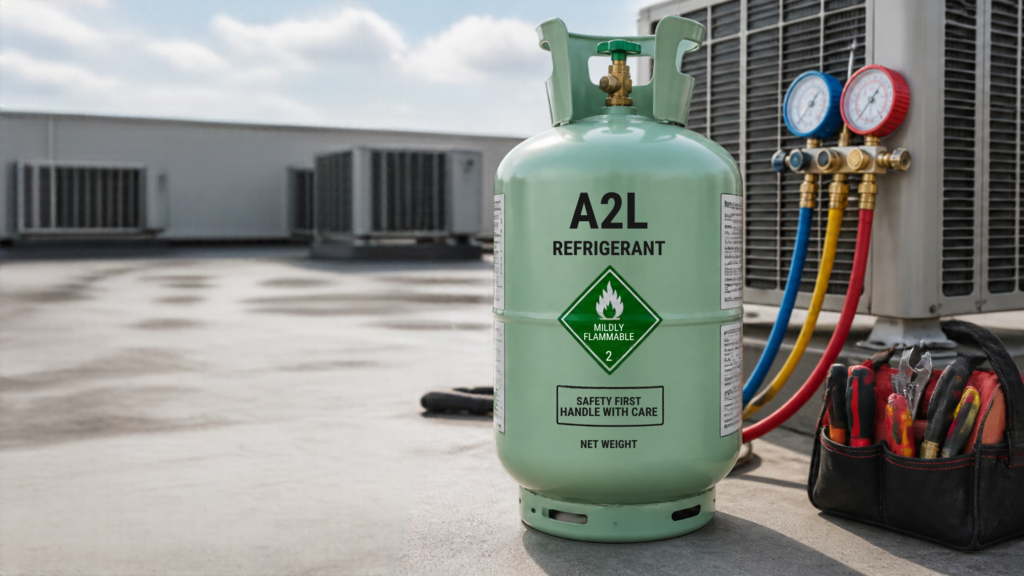
Since January 1, 2025, new residential and light commercial air conditioning and heat pump systems have been manufactured to use refrigerants with a GWP below 700, pushing most OEMs toward A2Ls such as R-454B and R-32. But R-410A is not disappearing from the service landscape anytime soon. A May 2026 EPA rule removed the installation deadline for equipment assembled from components manufactured before 2025, meaning technicians will continue working on both R-410A and A2L systems for the foreseeable future.
The key is knowing where A2Ls require a different approach, where established service practices still apply and how to handle both safely on the jobsite.
What Makes A2L Refrigerants Different
Under ASHRAE Standard 34, the “A” designates lower toxicity and “2L” designates lower flammability with a maximum burning velocity of 10 cm/s or less. To earn the 2L classification, a refrigerant must also meet thresholds for lower flammability limit (LFL) and heat of combustion. In the field, that translates to a refrigerant that requires considerable energy to ignite and, once ignited, burns relatively slowly—though it is still flammable.
R-454B (GWP 466) and R-32 (GWP 675) are the two A2Ls techs are most likely to come across in new residential equipment, with three distinct properties that matter on every service call:
- Heavier than air. Leaked A2L vapor tends to settle and pool in low areas, which is why refrigerant sensors on indoor units are typically positioned low, near the coil.
- Flammable within a concentration range. A2Ls won’t ignite below their LFL, which helps determine equipment charge limits and leak-mitigation requirements.
- Different charging behavior. R-454B is a blend of R-32 and R-1234yf and should be charged as a liquid, like other blends. R-32 is a single-component refrigerant.
Other Low-GWP Refrigerants Techs Will Encounter
A2Ls lead the transition in residential and light commercial HVAC, but they’re one part of a broader move toward low-GWP refrigerants:
- R-1234yf and R-1234ze(E): HFO refrigerants—both classified A2L—used in automotive AC, chillers and as components in blends.
- R-744 (CO2): Classified A1 with a GWP of 1. Transcritical systems operate at much higher pressures than HFC systems, requiring appropriately rated gauges, hoses and components.
- R-290 (propane): An A3 refrigerant with higher flammability, used in self-contained commercial refrigeration and some small equipment. It has more stringent charge limits and handling requirements.
A2L procedures center on ignition control and ventilation, with no carry over to A3 or high-pressure CO₂ work. Each refrigerant class calls for its own specialized training.
Working Across A2L and R-410A Equipment
By now, many techs have added A2L-rated tools to the truck. With R-410A systems still being installed and serviced, the bigger risk is mixing equipment between the two:
- Cylinder identification. A2L cylinders carry a red band or red top, left-hand threads and a pressure relief valve instead of a rupture disc. With both types on board, those markers offer the fastest check before connecting.
- Recovery cylinders. Keep A2L-designated cylinders separate from R-410A recovery tanks. Fill limits still apply, and because R-32 and R-454B are less dense than R-410A, maximum fill weight depends on the refrigerant going into it.
- Legacy equipment. Recovery machines, vacuum pumps and leak detectors that predate the transition may still be in service for R-410A work. Confirm the A2L rating before using any unit on an A2L system, since older equipment may contain switches or motors that can act as ignition sources, while older detectors may not reliably sense A2L vapor.
- Hoses and gauges. A2L cylinders require left-hand-thread hoses or adapters. A dedicated A2L set helps prevent cross-contamination.
- Equipment labeling. A2L units carry a flame symbol, providing a quick cue on jobs where both refrigerant types are in play.
Best Practices for Handling A2L Refrigerants During Service
Much of what separates a clean A2L repair from a risky one comes down to sequence. Manufacturer instructions govern, but a typical approach to opening an A2L circuit looks like this:
- Remove ignition sources from the work area and establish ventilation, paying particular attention to low spots where vapor can collect.
- Recover the charge completely with A2L-rated equipment. Knowingly venting R-32 or R-454B is prohibited under Section 608 of the Clean Air Act.
- Purge the circuit with oxygen-free nitrogen, evacuate, then repeat the purge to clear any remaining refrigerant. Never use compressed air or oxygen.
- Verify the area and circuit are clear with an A2L-rated leak detector before cutting or brazing.
- Braze with nitrogen flowing through the lines.
- Pressure test the circuit and check new joints with a bubble leak detector, then evacuate to the manufacturer’s micron target and charge by weight to the nameplate, staying within the system’s charge limit.
- Confirm the refrigerant detection system is connected and functioning per the manufacturer’s commissioning steps, and never bypass or disable a sensor.
Why Every Connection Counts on A2L Systems
A2L equipment is designed around charge limits based on the size of the room it serves, with a safety factor of four intended to keep a leak diluted well below the LFL. Above certain charge thresholds, units also include a refrigerant detection system that triggers a mitigation response—such as running the indoor blower—when concentrations reach 25% of the LFL. Those safeguards work best when the charge stays in the circuit, putting even more importance on joint quality: nitrogen-purged brazes, properly made flares torqued to spec and correctly seated valve cores. Field-made mechanical joints in occupied spaces must also meet equipment listing and installation requirements, so check the manufacturer’s instructions before choosing a flare over a braze indoors.
Nylog Blue supports that work at the connection level. Made from synthetic refrigeration-grade compressor oil, the gasket and thread sealant is fully miscible, compatible with system refrigerants and oils, and suitable for A2L applications. Applied to flares and threaded fittings, it forms a hydraulic seal that helps block high-pressure leaks, while coated gaskets resist drying out or becoming heat-fixed to the surface. Nylog Blue can also be used as an assembly lubricant for Schrader and ball valves, O-rings and shaft seals without contaminating the system, allowing techs to leverage the solution on A2L equipment with confidence.
Working Confidently with Low-GWP Refrigerants
The shift to A2L refrigerants has added new tools and service steps, but the fundamentals of good refrigeration work remain the same: complete recovery, disciplined brazing, clean evacuation and leak-tight connections. Techs who stay current on manufacturer instructions, local code adoption and refrigerant-specific training will be prepared to work across A2L and R-410A systems, along with the other low-GWP refrigerants entering the field.